

This is a joint opinion piece written by myself and Louisa Wall. She and I are both former Members of Parliament, and the founding co-chairs in New Zealand for the Interparliamentary Alliance on China (IPAC).
As I share on Substack today, The Post have kindly shared our thoughts while other legacy media outlets have chosen to ignore.
The sanctioning of four New Zealand Members of Parliament for visiting Taiwan is a matter of serious concern, not simply for those individuals, but for the integrity and independence of New Zealand’s democratic institutions.
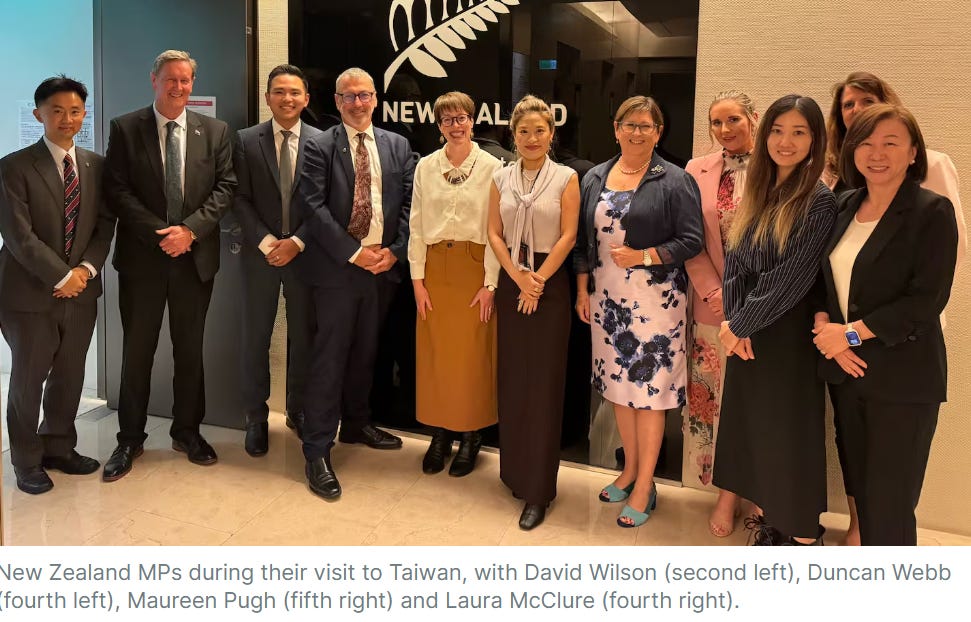
This issue extends beyond foreign policy. It raises fundamental questions about whether elected representatives can carry out their parliamentary duties free from pressure, intimidation, or coercion by foreign states.
The MPs concerned represent different political parties and travelled to Taiwan as part of their legitimate parliamentary activities. Reports that they have been banned from entering China, Hong Kong, and Macau, and that such sanctions could be reduced or lifted if they apologised for their visit, should concern all New Zealanders regardless of their political views.
New Zealand’s official position remains firmly committed to an independent, bipartisan foreign policy. Successive governments have emphasised that New Zealand makes its decisions based on its own values and interests, rather than alignment with any major power bloc. Prime Minister Christopher Luxon and Foreign Minister Winston Peters have both reaffirmed this principle, while also acknowledging that it must be exercised in a more complex and contested global security environment.
The significance of this development is heightened by New Zealand’s recent efforts to strengthen protections against foreign interference. The Crimes (Countering Foreign Interference) Amendment Act 2025 was introduced to safeguard democratic institutions and ensure that New Zealand’s political processes remain free from coercion and external influence.
While diplomatic disagreements between states are not unusual, attempts to pressure elected representatives to alter or recant legitimate political activities strike at the heart of democratic sovereignty. New Zealand MPs must remain free to meet, travel, engage, and exchange ideas with international partners without fear of foreign reprisal.
The experience of the European Parliament provides an important precedent. When Members of the European Parliament were sanctioned by China for their engagement with Taiwan and for expressing views on human rights issues, the European Parliament responded institutionally. It treated the sanctions not merely as an attack on individual members, but as a challenge to the independence and authority of the Parliament itself. Official dialogue was suspended and parliamentary solidarity was demonstrated across party lines. Ultimately, China lifted those sanctions.
New Zealand should consider a similarly principled response.
- Parliament should make clear that sanctions imposed on individual MPs for carrying out their duties are a matter affecting the institution as a whole. This could include:
- A cross-party motion affirming support for the four MPs and the independence of Parliament.
- An urgent debate on the implications of foreign sanctions against New Zealand parliamentarians.
- Consideration by the Privileges Committee or the Foreign Affairs, Defence and Trade Committee of the constitutional and democratic implications of such actions.
- A review of parliamentary exchanges and engagement while sanctions against New Zealand MPs remain in force.
This is not a question of supporting one political party, one country, or one foreign policy position. It is a question of whether New Zealand’s democratic institutions are prepared to defend their own independence.
The issue before us is simple: if foreign governments can penalise New Zealand MPs for where they travel, who they meet, or what views they express in the course of their parliamentary duties, then the independence of Parliament itself is at stake.
A confident democracy does not respond to such pressure with silence. It responds by reaffirming the rights, freedoms, and sovereignty that underpin its institutions.
Louisa Wall and Simon O’Connor are former Members of Parliament, and alumni members on the Inter-Parliamentary Alliance on China (IPAC)
Simon O'Connor a former National MP graduated from the University of Auckland with a Bachelor of Arts in Geography and Political Studies . Simon blogs at On Point - where this article was sourced.


2 comments:
Before NZ respond to China, let NZ respond to Trump first. Think that will happen? 😂😂😂😂
The two situations with Pres. Trump and China are poles apart therefore not relevant in this discussion IMHO
Post a Comment
Thank you for joining the discussion. Breaking Views welcomes respectful contributions that enrich the debate. Please ensure your comments are not defamatory, derogatory or disruptive. We appreciate your cooperation.