

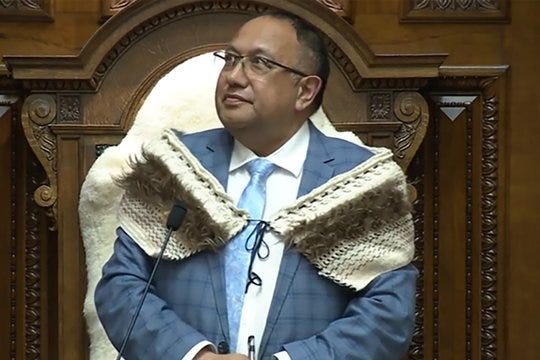
He was Speaker for only a little over a year, but he was fair, firm, and dignified. Before Gerry Brownlee was appointed after the 2023 election, I actually wrote that the incoming Government should consider keeping Adrian in the chair because he had been so good and genuinely evenhanded.
Politics contains plenty of people who desperately want the big jobs, but Adrian seemed to be somebody who ended up in the important role by virtue of the mana he quietly commanded. The Prime Minister described him as a Speaker whose fairness and calmness earned respect across the House. He deserved many more years beyond Parliament and I send my condolences to his whānau and the Labour Party.
Politics contains plenty of people who desperately want the big jobs, but Adrian seemed to be somebody who ended up in the important role by virtue of the mana he quietly commanded. The Prime Minister described him as a Speaker whose fairness and calmness earned respect across the House. He deserved many more years beyond Parliament and I send my condolences to his whānau and the Labour Party.
Election 2026: Policies, polls and personnel
National launched its campaign with 10 headline commitments, including no new taxes, compulsory KiwiSaver with higher contributions and its $1,500 Baby Boost, extending paid parental leave from 26 to 30 weeks, replacing NCEA, more police patrols, its supermarket competition policy, and returning the books to surplus. John Key also turned up to tell centre-right voters that splitting their votes was “the opposite of clever”, continuing National’s increasingly emphatic campaign against the strategic voting conversation bubbling away.
Labour, meanwhile, announced a bundle of democracy and transparency reforms including a mandatory code of conduct and public register for paid lobbyists, a stand down period for ministers who leave Parliament to become lobbyists, tighter restrictions on the use of urgency in Parliament, changes to the Official Information Act, restoration of election day enrolment, and changing the voting age to 16 for local elections.
My favourite Labour policy of the campaign so far might be what they call the Fair Go Law banning junk insurance, sneaky add-ons, and making subscriptions deliberately difficult to cancel. I say this as somebody who has fallen for the extended warranty / useless insurance routine an embarrassing number of times. There are few things I need the state to protect me from more urgently than a salesperson after a commission.
New Zealand First went in the opposite constitutional direction, promising to abolish the Waitangi Tribunal and replace it with a Treaty of Waitangi Completion Commission tasked with finishing historical claims lodged before 2008, while returning contemporary Crown-Māori policy work to the Ministry of Māori Development.
The 1News Verian poll produced the now familiar sight of both major parties looking rather less major than they used to, tied on 28%. The Greens were at their highest result in this poll at 16%, ACT 11%, New Zealand First 9%, Opportunity 6%, and Te Pāti Māori 1%.
Polling in some of the Māori seats added another level of intrigue. Te Pāti Māori is deliberately running an electorate vote strategy (splitting their vote!), telling supporters they can use their party vote elsewhere. A Mata-Horizon poll found the Greens on 28% among Māori roll voters, Labour on 27%, and Te Pāti Māori on 16% whereas among Māori on the general roll, Labour led on 38%, followed by the Greens on 17%, National on 11%, and New Zealand First on 10%.
In Te Tai Hauāuru, Debbie Ngarewa-Packer was on 38% for the electorate vote against Labour’s Te Pūoho Kātene on 27%, while in the party vote stakes Labour was on 26%, Greens 19%, and Te Pāti Māori 16%. In Te Tai Tonga things were even more interesting with incumbent (and now independent) MP Tākuta Ferris in last place on 15%. Labour’s Mananui Ramsden was leading the pack on 30%, ahead of Te Pāti Māori’s Lisa Marie Murch on 17%, and the Greens’ Lisa Te Morenga on 16%.
The fight over the fiscals was firmly on Labour’s funding hole. Nicola Willis updated National’s calculation of what they say are Labour’s unfunded promises to the tune of $18.8 billion. The arithmetic starts with about $27.1b of spending commitments and policy reversals, against roughly $8.3b of announced new revenue from Labour’s new Capital Gains Tax and scrapping Investment Boost.
Naturally, Labour says National’s number is misleading and promises everything will be reconciled in its forthcoming fiscal plan.
Election debates: Race, heckling, and woolly undies
We have now entered the glorious stage of the campaign where candidates spend their evenings in community halls being shouted at by strangers in the crowd and on the stage next to them.
The first Māori electorate debate produced one of the week’s more extraordinary exchanges. Green candidate Lisa Te Morenga attacked Labour’s Mananui Ramsden by saying “I think Labour’s position is really summed up by their billboards where everyone is standing behind the white man who leads their party. Including you, Mananui”. Debate moderator Maiki Sherman challenged her on this asking “Is there something wrong with being a white man?” Te Morenga was also reminded that one of her own party’s co-leaders is Chloe Swarbrick who is also white.
At an Auckland Central debate, ACT candidate Antonia Modkova said New Zealand had redressed historical wrongs through Treaty settlements but should not move forward with “two sets of people having two sets of rights, based on when their ancestors arrived”. This garnered boos from the K Road crowd and one heckler to yell “that’s racist bulls***.”
We therefore managed within about 48 hours to have one candidate criticised after explicitly making somebody’s race central to her attack and another accused of racism for arguing that ancestry should not determine rights.
The Federated Farmers rural debate at Mystery Creek contained more substantive discussion. About 350 farmers heard National, Labour, ACT, NZ First, and the Greens argue over forestry, the ETS, agricultural emissions, tax, and the continuing conversion of productive farms into carbon forestry. Labour’s Jo Luxton struggled to answer whether every farm in New Zealand was in fact a “family farm” or whether corporate owned farms would be subject to their CGT.
Todd McClay was not going to let her off the hook and proceeded to “what if” Luxton until cows came home. He also provided some cheekiness to the debate when he asked “can we have hands up who's wearing woollen socks and woollen underwear?” and then quipped “because I saw [Green’s] Steve [Abel] itching before”. Steve took it in good humour.
Election 2026: Bottom lines, wrinkly derrières, and ministerial ambitions
Opportunity announced 5 “non-negotiables”. Bottom lines they required for supporting a government. These were tougher Commerce Commission powers, regulation of lobbying and political donations, a 10 year health plan, phasing out bottom trawling, and recommitting to Paris Agreement obligations while protecting the Climate Change Commission from David Seymour’s swinging axe.
Notably their flagship policies were missing! The land tax policy and the UBI around which much of Opportunity’s campaign has been built did not make the cut. They still stick around like a bad smell, but are not dealbreakers.
Winston Peters responded with characteristic delicacy, describing Opportunity’s bottom lines as a “wrinkly derrière” and “flaccid bottom lines”. He also questioned how one would go about negotiating when they laid all their cards on the table in advance.
Labour then contributed its own bottom lines when Chris Hipkins declared 2 personnel matters absolutely non-negotiable. Number one was that he would be the Prime Minister and, two, Barbara Edmonds would be Finance Minister. He was responding to Chloe Swarbrick making clear she had designs on the Finance role much to the horror of anyone who votes centre-right (and many on the centre-left). Swarbrick bit back saying the “finance portfolio for voters to decide, not Hipkins”. Which is kind of partly true and partly false.
Election 2026: Complaints Department sides with National
National’s “No New Taxes” versus “9 New Taxes” billboard attracted 15 complaints to the Advertising Standards Authority from people arguing that the advertisement was false or misleading because Labour itself had not announced 9 new taxes.
The crucial bit of sleight of hand from the nifty Nats is that the billboard says “Labour Coalition”. National’s argument is that a Labour-led government would require support from parties proposing various additional taxes, and it supplied the ASA with a spreadsheet identifying nine of them. As a result the ASA complaints board, by majority, declined to uphold the complaints, finding that the ad presented National’s forward-looking opinion about a possible coalition and had adequately substantiated the claim.
National has also been flogging the aforementioned prospect of Chloe Swarbrick as Finance Minister across social media and fundraising emails and ACT responded to the latest poll with its own urgent fundraising pitch about keeping Labour out.
🇬🇧 Meanwhile, Britain is having problems
Britain has had one hell of a week. And my goodness, do they have problems. Five men in their early to mid 20s were arrested after 3 suspicious vehicles were seen near RAF Fairford in Gloucestershire, an airbase used by the United States Air Force and recently involved in American operations in the Middle East. Petrol was found in searches of the vehicles but no explosive devices. The 5 men, which media have breathlessly announced are “British nationals”, were arrested on suspicion of explosives offences and preparing a terrorist act and then released on police bail
Donald Trump was characteristically unimpressed by this British investigative strategy. “I would have said, ‘don’t let them have bail’,” he told reporters. And the man has a point. Not sure I have ever heard of terror suspects out on bail before. Prime Minister Andy Burnham has insisted they are under the strictest possible bail conditions. Excuse me for having my doubts.
The case took a turn a few days later when a 6th man, aged 25 and a dual UK-Iranian national, was arrested in Westminster on suspicion of preparing terrorist acts in connection with Fairford. Police say they are investigating all possible angles, including foreign state involvement. Burnham has said there are “strong indications” Iran played a part in the incident. Iran denies it. US Secretary of State Marco Rubio said the incident “clearly involves the hands of a foreign actor”.
The timing has made a photograph from only days earlier rather awkward. UK Foreign Secretary Ed Miliband met Iranian Foreign Minister Abbas Araghchi at the UN General Assembly and posed grinning and shaking his hand.
And that is not even the only astonishing British national security story of the week. Reporting by The Sunday Times says a man known publicly only as Mr X, who had served in the personal security detail of Hamas leader Ismail Haniyeh, was granted asylum in Britain and later British citizenship. He is now accused by German authorities of helping procure and move weapons for planned attacks on Jewish community centres, Israeli diplomats, and pro-Israel events in Germany and Austria. He was arrested in London in November 2025.
All of this made the Home Secretary’s announcement in the very same week particularly poorly timed and ill judged. Shabana Mahmood proudly announced she has reopened and expanded safe resettlement routes and will prioritise those from Palestine and Afghanistan. Those admitted through the scheme are to receive immediate indefinite leave to remain. Jewish community leaders have responded by asking for clear assurances about vetting for support for Hamas, Isis, al-Qaeda, and other extremist groups.
PREFU: Better books
The Pre-election Economic and Fiscal Update (PREFU) was considerably less grim than expected. Treasury now forecasts a $6.8b OBEGALx deficit in 2026/27, compared with $11.4b at the Budget, narrowing to just $800m the following year. The books are still forecast to return to surplus in 2028/29, but the projected surplus has increased from $2.6b to $4b. The Government is also expected to borrow about $15b less over the next 4 years and net debt is forecast to peak at 43.9% of GDP in 2028 before declining.
Nicola Willis was understandably pleased and described the forecasts as a distinct improvement. But the Government should not get too carried away. A large chunk of the improvement is higher tax revenue produced by higher and more persistent inflation. Core Crown tax revenue has been revised up by $11.4b across 4 years. Treasury expects tax as a share of GDP to rise from 27.6% to 29.1% over the forecast period.
There are also a plethora of potential risks far out of little ol’ New Zealand’s control. Oil is already about US$15 a barrel higher than the level used when key forecasts were finalised. The Middle East is a basket case. Trump loves a tariff. The war in Ukraine continues. China is eyeing up Taiwan. And the Pacific. Britain is quickly becoming an Islamic Republic. Parts of Europe are on fire. Oh and Rocket Man Kim Jong Un still has nukes.
Who’s gonna call it World War Three?
Labour’s response to PREFU (pardon that digression) has been to point out that the surplus still arrives later than Treasury once expected several years ago. Despite being part of the Government in charge, David Seymour pointed out that the fiscal position remains dramatically worse than projected in the 2023 PREFU and argued that the books require even greater restraint.
The Kingmakers’ Debate: Plenty of personality, not enough policy
Stuff’s Kingmakers’ Debate put Winston Peters, David Seymour, Chloe Swarbrick, Rawiri Waititi, and Qiulae Wong on stage with Andrea Vance and Jenna Lynch moderating. Given that their 5 parties collectively command an enormous slice of the current polling, this should have been an opportunity to interrogate the policies that could materially shape the next government. Sadly this opportunity was missed.
The questions felt as though they had been workshopped to create gratuitous discomfort and conflict for the sake of the clips on socials afterwards rather than to draw out interesting discussion.
The moderators began by asking the leaders what they earn and whether MPs are paid too much. While people might like to know how very well paid our politicians are, the line of questioning went on for far too long and was not particularly helpful for undecided voters given all politicians are paid according to independently set pay scales.
It was interesting that the politician who struggled the most to answer whether MPs should take a paycut was Comrade Chloe. She rejected the premise that political salaries were the real issue, called the fixation a red herring, and argued instead about union bargaining power. Which was an answer, I guess. By contrast David Seymour reminded Lynch and Vance that it was him who introduced a bill during Covid to cut MP pay by 20%. The Labour government amended it to 10% and so he gave another 10% to charity.
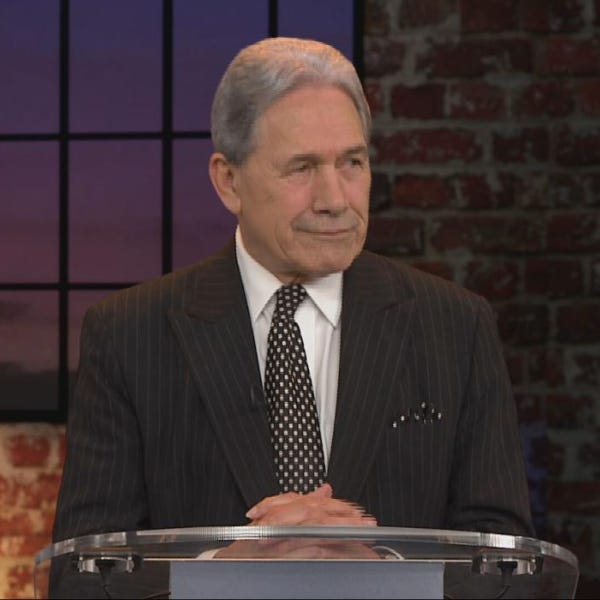
Later in more pointless questioning, Peters and Seymour were asked whether they actually liked and trusted one another. Peters afterwards called it a “brainless question”, saying he was there to govern with Seymour rather than like him.
The general consensus seems to be that Peters was the winner on the night simply by being unmistakably Peters. He reached repeatedly into his enormous personal archive of New Zealand political history, talked about growing the economy, took shots at both Christopher Luxon and Chris Hipkins, and eventually checked his watch because the moderators had said the debate would finish at 8.30 and he had somewhere to be.
Seymour was disciplined, largely sticking to ACT messaging of productivity, economic growth, primary healthcare, property rights, and opposition to governments forcibly breaking up private companies.
Waititi spoke heavily on Māori outcomes, healthcare, and low income families. He advocated for earlier access to superannuation for Māori, but largely did not seem to be across his brief. He struggled to answer questions giving vague responses.
Wong had a hard job as the only person on the stage who is not already an MP. It was her first major televised debate and she was up against 4 people well accustomed to fierce political conversations. Stuff described her as largely crowded out which is fair, but she did come across as sensible and well spoken. She was the only one to mention climate, environment, and emissions, which suggests a fair bit about Swarbrick’s priorities.
The debate was saved by the personalities on stage (mostly Winston), but it was pretty poorly done by Stuff. The two moderators regularly shared knowing looks and giggled to each other which was offputting. And most disappointingly, Andrea Vance did not call anyone a c***.
Local government: Voting, resigning, appealing
Auckland Council has voted to move away from postal voting and return to booth voting for the 2028 local elections, making Auckland the first council to make such a move since the early 1990s. It follows the court-voided Papatoetoe subdivision election and allegations involving stolen ballot papers in South Auckland.
The move is expensive with estimates ranging as high as $40m compared with around $16m for postal voting. Wayne Brown objected to spending tens of millions extra to fix voting irregularities that affected a relatively small number of seats. But Ōtara-Papatoetoe Local Board chair Apulu Reece Autagavaia countered that once people believe ballot papers can be stolen from letterboxes and used by somebody else, the cost of the election is no longer the only cost in play.
In Tauranga, chief executive Marty Grenfell has finally resigned after councillors held an emergency closed-door meeting concerning the Davison report into the Mount Maunganui landslide. The council-commissioned review described the disaster, which killed 6 people, as preventable and documented systemic failures and missed opportunities over decades. Grenfell had insisted after the report that he remained the right person to lead the organisation. Six weeks later, he is gone.
The council has declined to say whether Grenfell was asked to resign or whether he will receive a payout. Given his total remuneration was just under $600,000 and the circumstances of his abrupt departure, those are not unreasonable questions.
And in Nelson, councillor Tim Skinner has had his conviction for breaching a protection order quashed and has been discharged without conviction by the High Court. Skinner had pleaded guilty after leaving flowers at his estranged wife’s address and later sending 12 unrelated personal messages after she contacted him about collecting documents. The District Court found the messages were not abusive but did breach the order. A conviction would have automatically vacated his council seat, which became central to the appeal. He will now return to council duties.
If you can’t beat ZB, hire the bloke running it
Jason Winstanley has been appointed chief executive of RNZ in a genius move. If somebody keeps beating you, hire him.
Winstanley has spent years in senior NZME radio roles, including heading Newstalk ZB and, since 2021, running NZME’s wider audio operation.
RNZ chair Brent Impey has been clear the public broadcaster wants to compete harder for audiences. It is difficult to imagine a clearer signal than this move that RNZ’s new board understands that public broadcasting cannot fulfil much of a public purpose if the public increasingly does not want to listen.
RNZ is splitting the chief executive and editor in chief functions so Winstanley’s job is the organisation, audience, and strategy rather than personally deciding what goes in Morning Report tomorrow.
Pay equity: What everyone is actually arguing about
Pay equity has become one of the most emotive issues of the campaign, but it seems that not everyone understands what everybody is actually fighting about.
To start of with, pay equity is not simply equal pay for a man and woman doing the same job. That is equal pay. Pay equity deals with different jobs that are argued to be of equal value, particularly where that work is predominantly performed by women and may have been historically undervalued. A classic example is comparing the skills, responsibility, effort, and conditions involved in female-dominated care work with male-dominated comparator occupations. The problem that has arisen is disagreement about what fair and appropriate comparator occupations are.
Under previous New Zealand pay equity settlements, teacher aides were compared with Corrections officers, Customs officers, and youth justice workers. Oranga Tamariki social workers were compared with detectives, constables, air traffic controllers, and engineers. Health NZ clerical and administration workers were compared with fishery officers, Corrections officers, Customs officers, and mechanical engineers. Care and support workers, in the original 2017 settlement, were compared with mental health assistants.
The Coalition did not abolish pay equity as a legal concept, but it did tighten the regime substantially. The new rules increased the threshold for a female-dominated occupation from 60% to 70% female, required the work to have been predominantly female for at least 10 years, changed how comparators could be selected, and cancelled existing claims so they would have to be resubmitted under the new test. The Government’s argument was that the previous system had allowed claims to progress without sufficiently strong evidence of sex-based undervaluation and had created potentially enormous bills for the government.
Treasury had at least $12.8b sitting in two active pay equity contingencies. When the system changed, that money was returned. Just under $11b was operating expenditure and $1.8b capital.
The narrative that “the Government abolished equal pay for women” is an emotionally devastating campaign line but not a particularly accurate description of what happened.
Labour has promised to restore the previous settings within its first 100 days in office. The Greens have promised much the same though are already promising billions to various sectors without negotiations even having taken place.
The difficulty for Labour is that Chris Hipkins previously said Labour would set out what reversing the changes would cost and how they would pay that cost. Now he says pay equity will not appear as a specific line item because governments do not publicly reveal bargaining envelopes. Barbara Edmonds says there will be a “sufficient contingency” in Labour’s fiscal plan but has repeatedly declined to say what that number is.
There is a very obvious public interest problem when a party promises to reinstate a system associated with billions of dollars of liabilities but asks voters to take a leap of faith that Chippy of Covid spending fame has it under control.
Climate activists complain about New Zealand
New Zealand has been accused of breaching the climate provisions in our Free Trade Agreement with the European Union. The complaint has been lodged through the EU’s Single Entry Point mechanism by Dutch environmental organisation Both ENDS, with support from New Zealand groups and individuals including Greenpeace, Ngāti Pūkenga, OraTaiao, the Environmental Law Initiative, Mike Smith, and Jane Kelsey. It alleges New Zealand has weakened environmental protections and is failing to effectively implement the Paris Agreement.
Trade Minister Todd McClay says New Zealand is compliant with the FTA and argues that how the country meets its obligations is for New Zealand to determine.
In the discussions of this, there has been some speculation of the role of the Green Party and in particular Chloe Swarbrick in the accusations. To be clear, the Greens deny this.
The connection, however, is being made with the fact that Swarbrick and Belgian Green politician Saskia Bricmont wrote to EU Trade Commissioner Maroš Šefčovič back in April asking the Commission to examine whether New Zealand’s methane changes could breach the very same trade agreement. The EU Trade Commission declined to launch the investigation they sought. The new action is a separate complaint. I have said before that it was extraordinary for a New Zealand MP to tattle on her own country to foreign institutions about things that could potentially affect New Zealand exporters.
There is another useful bit of context missing from this pearl clutching and chest beating over Paris and that is that almost everybody is failing. The UN Environment Programme’s 2025 Emissions Gap Report found that even full implementation of countries’ current national pledges would put the world on a path to roughly 2.3–2.5°C of warming, while current policies put it around 2.8°C. It also said G20 members collectively are not on track to even achieve their existing 2030 NDC targets.
The Climate Action Tracker tells much the same story. The United States, UK, EU, China, India, South Korea, Russia, and others are all projected above the Paris ambition associated with 1.5°C. Some are not even on paths compatible with 2°C. Did you notice the EU in that list?
Anna Lorck and the lost art of talking to people you disagree with
A round of applause for former Labour MP Anna Lorck please, everyone. Lorck is co-hosting the Taxpayers’ Union’s electorate debate series with libertarian liquidator Damien Grant. She is representing a perspective from the left. The debates are organised to be balanced and represent a broad spectrum of views. Then Nicky Hager’s poisonous novella Dirty Work came out, Labour and the Greens pulled out of the remaining Taxpayers’ Union debates, and suddenly Lorck was being pressured to quit too.
In a move that is sadly refreshing in its rarity, Lorck responded “I’m there as a left winger. My job was to bring in the left wing. Clearly I’ve failed in that now, but they were coming,” she said. “That’s not an excuse to quit in my book ... If you’re not in the room, you’re on the menu.”
Lorck clarified she has not read Hager’s book (just like the entire New Zealand population bar about 200) and does not agree with everything the Taxpayers’ Union has done. The Union disputes significant allegations in the book, including an alleged sexual harassment settlement, and says Hager did not approach them for comment before publication. Hager has since admitted that some of his destructive accusations were not “rock solid”. As the subject of one of his chapters I can assure you that a great deal of the book is total fiction and speculation. If anyone is engaging in dirty politics it is him.
Anyway, if you know Anna Lorck please extend my round of applause to her. It is unfortunate that the debate series has become collateral damage.
🇦🇪 🇮🇱 Terror attack averted in the skies
In a week of pretty extraordinary news stories about terrorism here comes another and this one has a New Zealand connection. Flydubai flight FZ1073 was travelling from Dubai to Tel Aviv when a violent struggle erupted in the cockpit. The captain, Smit Machchhar, was stabbed by his co-pilot and the aircraft plunged around 15,000 feet in less than a minute. Machchhar managed to fight for his life to get to the cockpit door open, allowing cabin crew and passengers to reach the flight deck and overpower the terrorist pilot. Reserve pilots aboard the aircraft then recovered control and landed it safely at Tabuk in Saudi Arabia.
Israeli officials have described the incident as an attempted terrorist attack and say the suspected attacker, an Omani national, intended to crash the aircraft. The UAE has opened an investigation specifically looking for prior planning or direction.
What was truly incredible was the astonishingly brave people on board. Passengers ran towards a cockpit from which they could hear screaming, forced their way inside, and helped restrain an armed man while the aircraft was diving rapidly.
And of course, Captain Machchhar, badly wounded, remained conscious long enough to help get them access. This is where the connection is. Machchhar trained with Mainland Air in Dunedin for about 18 months in 2008–09 and has remained connected with the company as a recruitment agent in India. Mainland Air chief executive Philip Kean taught him 18 years ago and described the how the plummet could well have resulted in the plane coming apart.
The fact that 174 people walked away from that aircraft is down to a wounded pilot, a handful of people who ran towards a knife instead of away from it, and those who took over a plunging Boeing.
In short — other stuff that happened
- 🇺🇸 Former American Idol contestant Caleb Flynn has been found guilty of murdering his wife Ashley. He shot her twice in the back of the head while she slept and staged a break in because he was having an affair with a much younger woman from church.
- Three members of the same family (two allegedly children) were found dead at a Papatoetoe home on Thursday night. Police say the incident was isolated, they are not seeking anybody else, and there is no ongoing risk to the public.
- 🇦🇺 Australian teacher Deandra Kontou (32) has been charged with 9 child abuse offences involving a student, including aggravated sexual assault and grooming. Some of the alleged offending occurred during a school trip to the Great Barrier Reef. She has been granted bail and barred from entering schools or teaching children while the case proceeds.
- Up to 15 pygmy killer whales have died after stranding along several kilometres of 90 Mile Beach. DOC says an unknown number may have refloated, and it is working with Ngāti Kuri, Ngāi Takoto, and Te Aupōuri on the response and burial.
- New Zealand universities continue their slide in the Times Higher Education rankings. Auckland fell to 168th globally, Otago sits in the 351–375 band, and Victoria in the 401–450 band. Canterbury was the only New Zealand university to improve.
- A man charged with assault in relation to the Rotorua triple homicide in which a woman and two children aged 3 years and 11 months were killed has been granted electronically monitored bail. His name remains suppressed until his next appearance in January.
- Christchurch Police have searched the house where missing Braydon Hepworth (21) was last known to live. He has not been seen or heard from since September 14 and Police say they are very concerned for him. Call 105 if you have any info.
- Former Christchurch Hospital nurse and massage therapist Neil Yardeni has been sentenced to 11 years and 3 months in prison after being found guilty on 21 charges including rape, indecent assault, and making intimate recordings. The court found he sexually assaulted 14 women and secretly filmed another. He continues to deny wrongdoing and plans to appeal.
- Actor Cliff Curtis suffered internal injuries after the customised Tesla he was driving crashed into a parked taxi on Auckland’s waterfront. One person in the taxi was seriously injured. Curtis said he assisted injured people with first aid before emergency services arrived and is cooperating with the police investigation. No charges have been laid.
- Police have revoked the firearms licence of a student at an Auckland private school and seized firearms he had access to after allegations that he sent images of guns and threats to other students on social media.
- Woolworths is pressing ahead with moving 130 New Zealand customer service jobs to Sydney. The company says it will offer redeployment and redundancy support but the union representing affected workers describes the decision as short-sighted, particularly for staff who took the jobs because they could work remotely.
- TAIC has released its final report into a 2023 Air New Zealand near-miss at Timaru, when a Q300 descended about 1000 feet below the minimum safe altitude during a night approach. The report found deficiencies in training and oversight and said the CAA’s relationship with Air New Zealand had become “too close in nature”.
- National released Electrify NZ 2.0, a 9 point energy package including changes to lines-charge regulation, allowing households with solar or batteries to sell electricity to any buyer, making affordability an objective of the Electricity Authority, and requiring new AI data centres to bring their own firmed generation. Labour’s Megan Woods called it an “absolute fizzer”.
- Political parties have received $629,322 through the protected-from-disclosure donation scheme so far this year. NZ First received $161,000 through it in the latest 3 month period, taking its annual total to $173,162 while National’s annual total from the scheme was $346,160. The scheme is entirely lawful and keeps the donor’s identity secret from both the public and the receiving party.
- The future of Chateau Tongariro remains up in the air though Iwi representatives have expressed a preference for demolishing it entirely and replacing it “with a cultural centre which better integrates with the maunga and respects cultural heritage”. Officials estimated reopening the Chateau could generate about $56 million in regional economic benefit over 60 years while preserving the heritage building.
- Greg O’Connor has gone directly from Parliament to Wellington City Council. The former Labour MP was elected unopposed to the Takapū/Northern General Ward following councillor Tony Randle’s death and says he intends to sit as an independent.
- 🇫🇷 Student protests in France escalated into serious disorder, with hundreds of arrests, dozens of injured police officers, and attacks on schools. In Marseille, staff at one high school were reportedly splashed with petrol during an attempted arson attack, while another school entrance in Nantes was destroyed by fire. There is footage online of a firefighter being set alight by protestors.
- 🇬🇧 A Jamaican man convicted of raping both his wife and his sister won his UK deportation appeal after a tribunal accepted that returning him to Jamaica would breach Article 3 of the European Convention on Human Rights because he is now bisexual and in a relationship with a man so would face a risk of serious harm.
I have been thoroughly enjoying Free To Disagree, the podcast hosted by Damien Grant and Oliver Hartwich. They describe it as “a weekly conversation about New Zealand politics and economics with Oliver Hartwich and Damien Grant. Two friends on broadly the same side of politics who find plenty to disagree about anyway. Each week they discuss three big issues, leading up to the election.”
There is plenty of lightheartedness and good natured winding each other up, but underneath it the policy discussion is intelligent and informative. The blurb for this week’s episode is:
“The Treasury's pre-election update showed spending up, revenue down and debt rising after three years of a government elected on restraint. Oliver and Damien ask who ends up as finance minister after 7 November, and whether any of them will confront superannuation and interest heading for $44 billion by 2031. They then turn to John Key, who has warned the National Party conference against tactical voting, with a National overhang now a real prospect. They finish the episode on National and Labour's combined share falling to 56 per cent, a historic low, which Oliver's new Quadrant essay traces to the big parties losing their members, their loyalty and their links to the communities they once represented.”
Ani O'Brien comes from a digital marketing background, she has been heavily involved in women's rights advocacy and is a founding council member of the Free Speech Union. This article was originally published on Ani's Substack Site and is published here with kind permission.


8 comments:
On race and in pure Progressives absurdity, Green candidate Lisa Te Morenga reminded us of the mindlessness of bigotry and 101 racism and how it contributes nothing but negative outcomes.
Not that I rate Chris Hipkins whatsoever, but if to follow Te Morenga's racist diatribe, it's not what's in Hipkins head that matters, it's the aesthetics, eugenics and skin tone backed by some sort of claim of racial grouping is all that matters for a leader and a candidate.
Te Morenga's crack at using the Third Reich's, Rassenhygiene, to purify the room is yet another example of these bigots saying the quiet part out loud.
It also immediately tells us she is very uncomfortable with Swarbrick, (most people are but not for her genetics), as she is racially inferior and how unglued the Green Party really is.
It's no surprise that the party that self loathes the European culture and thrives of critical race theory would be like this but when a candidate openly hates their leader based on her race, things are very problematic. As in out the gate problematic for a political party.
Perhaps Chloe, the pseudo Finance Minister, should do the decent thing for Green Party philosophy and pull the pin now! I did wonder at what point in the madness that is the Green Party, where they would turn on themselves and their white skinned blue eyed leader. Now I no longer have to wait.
I had an idea, folks commenting on this site should have to click a couple of extra boxes first to say firstly whether they are left or right and secondly whether they are a citizen, resident, or someone from overseas. Then we can get to the bottom of what’s what. Kiwis should get precedence and there should be a limit on how many leftist comments are allowed per day
>"... to say firstly whether they are left or right..."
The extremes are simple enough to identify but drawing a line somewhere in between invites the Sorites Paradox to make an appearance which defeats the purpose of the exercise. Perhaps left or right or centrist, but many extremists dislike being thought of as extreme so they will tick "centrist". Nah, this ain't gonna work.
>"...whether they are a citizen, resident, or someone from overseas"
Citizens and permanent residents can both vote, collect Super, and lots of other things as per NZ law. This website should not distinguish between them either. 'Someone from overseas' - what if that person is a NZ passport holder and is a long-term expatriate overseas (as I was for 35 years)? Nah, this ain't gonna work either.
>"Kiwis should get precedence"
Define 'Kiwi' please. As I have commented in these columns before, it is deucedly difficult to define a NZ culture. I have been a NZ passport holder since 1972. I don't like rugby, though. Do I qualify?
>"... there should be a limit on how many leftist comments are allowed per day"
It should be quality and not quantity that counts. We have to be careful that we don't become an echo chamber for people who agree with us. Debate is healthy in a democracy - informed debate, that is.
As a rule, I never fall for the "extended warranty / useless insurance routine" but in 1992 we bought a new car, a Ford Laser in Adelaide and when the extended warranty was offered, for reasons unknown to me, I said, "why not" and paid something like $700. In the extended period our gearbox threw a fit. The job came to something like $10,000 after several attempts to fix it. $700 well spent ???? Guess I got lucky.
In reply to Anon: 9.12am,
The ordaining of laws in favour of one part of the nation, to the prejudice and oppression of another, is certainly the most erroneous and mistaken policy.
Benjamin Franklin
OR
Either write something worth reading or do something worth writing about .
Benjamin Franklin
Re Chloe, Green Party, Maori Party, Nazi Party: Any group of people whose self -image involves any kind of "purity" moral, racial, religious will always eventually organize itself into a "circular firing squad" where the original group fragments into subgroups, each claiming to be "more pure" than any of the others. Then each group starts to attack the "less pure" and that's the Circular Firing Squad in action. This is a function of human behaviour which still has a deep basis in our hundreds of thousands of years living in small tribal groups. IN group versus OUT group. I doubt if humanity will ever outgrow this archetype. It just there lurking in the collective unconscious. It is possible with serious self-conscious work of an individual to come to terms with this archetype and learn how to move past it's negative influences. It is NOT possible for a group to do this as a group; it has to be done on the individual level. How many people are prepared to put in the hard work on themselves? Much easier to perfect the art of Virtue Signaling, join the Cricular Firing Squad and attack the OTHER.
“Define 'Kiwi' please. As I have commented in these columns before, it is deucedly difficult to define a NZ culture. I have been a NZ passport holder since 1972. I don't like rugby, though. Do I qualify?”
If you haven’t figured it out after 50 years, I’m sorry, but there must be something wrong with you. Either you’re living in a cave or living in denial. To suggest that liking rugby is a cornerstone of kiwi culture shows just how out of touch you are. 50 years and you still haven’t a clue? Really?
Oh dear, s/he can't define 'Kiwi', and is evading the question. Must be that troll that's been butting in lately...........
Post a Comment
Thank you for joining the discussion. Breaking Views welcomes respectful contributions that enrich the debate. Please ensure your comments are not defamatory, derogatory or disruptive. We appreciate your cooperation.